




Apple ML Research open-sourced FastFrames, a family of autoregressive two-step video diffusion models that target interactive latency at 480p, with weights on Hugging Face and code at github.com/apple-aiml-research/ml-fastframes. The project page positions FastFrames-S (1.3B) at roughly 36 ms per frame on one B200-class GPU and FastFrames-L (14B) at 45 ms per frame on eight GPUs, while matching or beating slower baselines on quality metrics.
This is not an iPhone photo filter. It is a research release for builders who want local, camera-steerable video generation with measurable frame latency.
What Apple shipped
Apple lists four deliverables on the FastFrames-L model card:
| Asset | Size | Role |
|---|---|---|
| FastFrames-S | 1.3B | Speed-first autoregressive generator |
| FastFrames-L | 14B | Higher-quality distillation from Wan2.1-14B |
| LingBot optimized | 1.3B | 16x faster camera-conditioned control |
| Code + checkpoints | GitHub + HF | uv sync, benchmarks, demo server |
Outputs are 832 x 480, 81 frames, 16 fps for standard text-to-video generation via scripts/generate.py.
Why latency, not just FVD
 Open model weights release metaphor for Apple FastFrames Hugging Face checkpoints
Most video diffusion stacks spend multiple seconds per clip. That is fine for offline ads, but useless for live camera steering where each new keystroke or joystick move should refresh the scene.
The FastFrames abstract argues prior autoregressive models were at least an order of magnitude too slow for fluid interaction. Apple's response is engineering on the whole pipeline, not only the transformer:
- Replace heavy VAE decode with a lightweight pixel decoder path
- Treat KV cache refresh as a first-class cost center
- Keep generation at two diffusion steps per frame via Causal Forcing++
On one GPU, the model card breaks down FastFrames-S component timing:
| Stage | Latency |
|---|---|
| DiT at t=1000 | 16.1 ms |
| DiT at t=833 | 16.2 ms |
| KV refinement | 2.2 ms |
| Pixel decoder | 0.9 ms |
| Total | 35.4 ms |
Those numbers come from Apple's published benchmark script evaluation/latency/benchmark.py ff-s.
FastFrames-L and the Wan2.1 distillation chain
FastFrames-L is not trained from scratch in one shot. The README on Hugging Face documents a four-checkpoint distillation ladder from Wan-AI/Wan2.1-T2V-14B:
- Causal teacher on Wan2.1 latents
- Consistency-distilled two-step causal model
- DMD-distilled model
- Final generator plus pixel decoder and KV refinement nets
FastFrames-S instead freezes a frame-wise Causal Forcing++ generator and trains surrounding networks.
For readers tracking open video stacks, this sits beside MBZUAI PAN 2 (simulative reasoning) and consumer tools like Suno Visuals (music video). FastFrames optimizes per-frame responsiveness, not long narrative coherence.
Interactive demo: LingBot and camera control
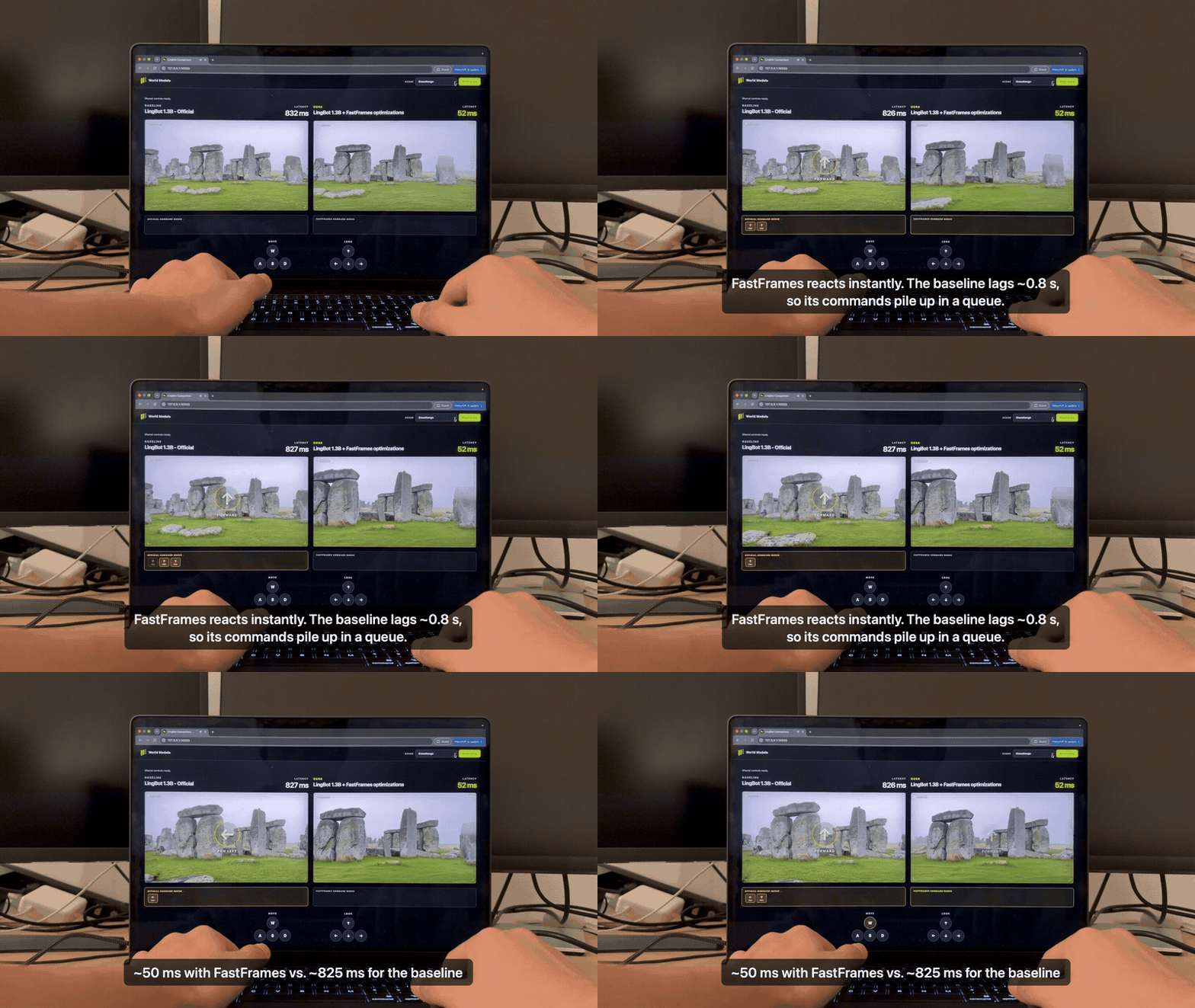 FastFrames demo showing LingBot camera control optimized for interactive video generation latency
Image: Apple ML Research
Apple highlights camera-conditioned interaction. After demo setup, you can run:
CUDA_VISIBLE_DEVICES=0 uv run --extra lingbot --extra demo python apps/lingbot/demo.py --gpus 1
Then open http://localhost:8000. An eight-GPU path exists for throughput testing.
The project page hosts side-by-side clips comparing Causal Forcing++, Krea, and FastFrames variants on shared prompts. That is the fastest way to see what "interactive latency" buys visually before you download weights.
How to install and run text-to-video
Requirements from Apple's README:
- Linux x86-64
- NVIDIA GPU with CUDA 12.8 driver
uvpackage manager
Workflow:
- Clone
apple-aiml-research/ml-fastframes uv syncat repository root- Download checkpoints per the checkpoint guide in
docs uv run python scripts/generate.py --model ff-sorff-l
Latency sweep:
uv run python evaluation/latency/benchmark.py ff-s
uv run python evaluation/latency/benchmark.py ff-l --gpus 8
Quality reproduction uses the VBench guide referenced on the model card for Table 1 Quality / Semantic / Total scores.
Apple text to video versus iPhone editing
Searchers often confuse FastFrames with adding text captions in Apple Photos. FastFrames is generative video from prompts on a Linux workstation, not an iOS editing feature. If you need on-device SLMs, see Mobile AI Factory instead.
Licensing and what you can ship
| Component | License |
|---|---|
| FastFrames code | Apple Sample Code License |
| LingBot-World v2 | CC BY-NC-SA 4.0 upstream |
| Model weights | Published under the apple org on Hugging Face per the model card |
Research and internal demos are the natural fit. Commercial redistribution requires a legal read of Apple's sample code terms and LingBot's NC clause.
What developers should benchmark first
Before you compare FastFrames to a hosted API:
- Cold versus warm latency: first
generate.pyrun includes compilation and IO. - GPU class: Apple quotes B200-class nodes; your 4090 numbers will differ.
- Prompt suite: use
scripts/generate_project_page.pyfor the 20+ standard prompts. - Camera demo path: test LingBot if your product needs live control, not batch MP4s.
Training pipeline: Causal Forcing++ to product checkpoints
Apple documents two training recipes on Hugging Face:
FastFrames-S (1.3B): Start from a frame-wise Causal Forcing++ generator, keep it frozen, and train peripheral networks. That limits drift in the causal backbone while you optimize decoders.
FastFrames-L (14B): Distill Wan2.1-14B into a two-step causal student, then apply the same pixel decoder + KV refinement recipe as FastFrames-S. Released artifacts include the teacher, consistency model, DMD student, and final generator bundle.
For researchers comparing distillation fidelity, Apple publishes project page videos with shared seeds across Causal Forcing++, Krea, and FastFrames exports. Use those clips before you trust a single VBench row.
Hardware expectations
| Workload | Documented hardware |
|---|---|
| FastFrames-S latency bench | 1 GPU, 480p, full KV cache |
| FastFrames-L latency bench | 8 GPUs (--gpus 8) |
| LingBot interactive demo | 1 or 8 GPUs |
| Paper headline (S) | Single B200, ~36 ms/frame |
| Paper headline (L) | 8x B200 node, ~45 ms/frame |
Consumer RTX 4090 runs may work with smaller batches, but Apple does not list them as reference platforms. Benchmark before you promise SLA numbers in a product.
Cost versus hosted video APIs
Closed APIs charge per second or per job with opaque queueing. FastFrames shifts cost to your GPU-hour bill plus engineer time downloading Wan-derived checkpoints.
| Factor | Self-hosted FastFrames | Hosted video API |
|---|---|---|
| Latency control | You measure benchmark.py | Vendor queue + network |
| License | Apple sample code + NC LingBot | Terms of service |
| Custom prompts | Full generate.py access | Rate limits |
| Camera steering | LingBot demo path | Often unavailable |
For teams already running vLLM Rubin throughput experiments, FastFrames is a separate stack (uv, DiT, KV refinement). Do not assume one CUDA environment serves both without container separation.
Evaluation and reproducibility
Apple points to VBench reproduction for Table 1. The workflow in the model card:
- Install per README.
- Download checkpoints listed in the checkpoint guide.
- Follow
docs/evaluation.md(linked from Hugging Face) for quality metrics.
Run evaluation/latency/benchmark.py before quality sweeps if your claim is interactive generation. Marketing teams often mix latency and FVD from different tables; keep them separate in slide decks.
Project page prompts
scripts/generate_project_page.py regenerates 20+ showcase prompts for both ff-s and ff-l. That script is the fastest way to build an internal A/B panel without inventing prompts that favor your fine-tune.
Wan2.1 lineage and why distillations matter
FastFrames-L sits on the Wan 2.1 text-to-video ecosystem explainx.ai readers already encounter in open video research. Apple does not hide that dependency: the Hugging Face model tree shows Wan-AI/Wan2.1-T2V-14B as the base with 88 downstream finetunes including FastFrames-L.
Distillation buys two things:
- Step reduction: two diffusion evaluations per frame instead of long schedules.
- KV refinement: a dedicated network that keeps autoregressive memory sharp without full attention recomputation every frame.
If you maintain Wan forks, compare your teacher checkpoint hashes against Apple's published ladder before merging weights. Silent mismatch produces colorful but incoherent motion.
When to pick S versus L
| Choose FastFrames-S | Choose FastFrames-L |
|---|---|
| One GPU prototyping | Eight-GPU quality panels |
| Latency demos under 40 ms | Marketing clips where detail wins |
| LingBot-style interaction | Batch MP4 for storyboards |
You can run both from one clone; only checkpoint downloads differ.
Security and content policy notes
Interactive text-to-video at 16 fps enables rapid iteration on sensitive prompts. Apple's license is research-oriented; your product still needs abuse monitoring like any generative media stack.
Pair organizational policies with human review when prompts come from end users, not fixed generate_project_page strings.
Common setup failures
| Failure | What to check |
|---|---|
uv sync missing CUDA | Driver must match CUDA 12.8 note in README |
| Checkpoint not found | --checkpoint-dir must match download layout |
| LingBot demo import error | Install --extra lingbot --extra demo |
| Huge GIF in docs | Demo assets are large; serve from local outputs/ |
How this fits Apple's wider ML posture
Apple rarely drops large generative checkpoints. FastFrames follows other open research artifacts explainx.ai has covered in the Apple orbit, including on-device efficiency work and multimodal research releases.
For builders comparing open weights against Gemini or OpenAI video APIs, FastFrames is a latency anchor: you trade managed scaling for known milliseconds per frame on hardware you rent.
Maintainer citations
If you publish academic work using these weights, cite the BibTeX block on Hugging Face (chou2026fastframes). List checkpoint revision, GPU count, and whether clips came from ff-s or ff-l so others can reproduce latency claims.
Store raw MP4 outputs alongside generate.py logs. Apple’s project page comparisons use fixed seeds; drifting seeds make internal demos look worse than public clips even when weights match. Pin the Git commit hash in lab notes when you bisect regressions across Apple uploads.
Related reading
- MBZUAI PAN 2 open world model
- Suno Visuals and Minimax music video launch
- Mobile AI Factory on-device agents
- LynnReal-Hand hand-controlled world model
- Bria RMBG open weights comparison context
Sources: apple/FastFrames-L, FastFrames project page, and ml-fastframes GitHub as of November 18, 2026.