



Looking for the learning infrastructure to back this up? explainx.ai gives teams a curated skills registry, daily AI news, monthly course drops, and an AI chatbot — the ongoing signal layer that makes AI upskilling stick. $29/month per person. The AI Maker Bootcamp is available for teams that want cohort-based, structured learning.
Most organizations have now run at least one round of AI training for their teams. A workshop, a vendor demo, a course reimbursement policy. And most of them are finding the same thing six months later: the tools are still being used by the same ten people who were already using them before, and the broader team has largely reverted to whatever they were doing before.
This is not a motivation problem. Most employees are genuinely curious about AI. It is a design problem. The learning structures being used are not built for how AI skills actually develop — and they are not built for how fast the field moves.
This guide explains why common approaches fail, what the research and practitioner experience says actually works, and how to build a learning structure that builds and maintains AI fluency rather than creating a temporary spike of interest.
Why Most Corporate AI Training Fails
It is treated as an event, not a system. A workshop or a two-hour lunch-and-learn might shift awareness, but it cannot change habits. AI skills — like any skill — develop through repeated practice with feedback, not through a single exposure. Organizations that run a one-time training and check the box are not building fluency; they are creating the appearance of it.
It is untethered from real work. Generic AI training that teaches employees to use ChatGPT with example prompts from unrelated industries does not transfer to their actual job. The most effective upskilling happens when people learn to apply AI to a specific, real task they do repeatedly. Abstract capability does not activate until there is a concrete problem to solve.
It treats AI as a tool to learn once, not a field that changes. An employee who took a solid AI course in early 2025 now has partially obsolete knowledge. Not because the fundamentals changed — prompting principles and evaluation habits still apply — but because the specific capabilities, tools, and best practices have evolved substantially. A training structure that does not have a maintenance layer becomes stale quickly.
It does not distinguish between roles. A one-size-fits-all AI training that tries to serve a software engineer, a financial analyst, an HR manager, and a sales rep in the same session serves none of them well. The tools are different. The failure modes are different. The highest-leverage applications are different. The best upskilling programs treat role-specific application as a first-class consideration, not an afterthought.
It measures the wrong thing. Course completion rates and quiz scores are easy to measure, but they do not predict behavior change. Organizations that measure AI upskilling success by completion rates end up optimizing for completion rather than capability. What matters is whether people's work is changing — whether they are using AI for tasks they would not have used it for before, and whether the outputs are good enough to trust.
What Genuine AI Fluency Looks Like
Before designing a learning program, it helps to define what you are building toward. "AI fluency" is used loosely enough that it needs to be unpacked.
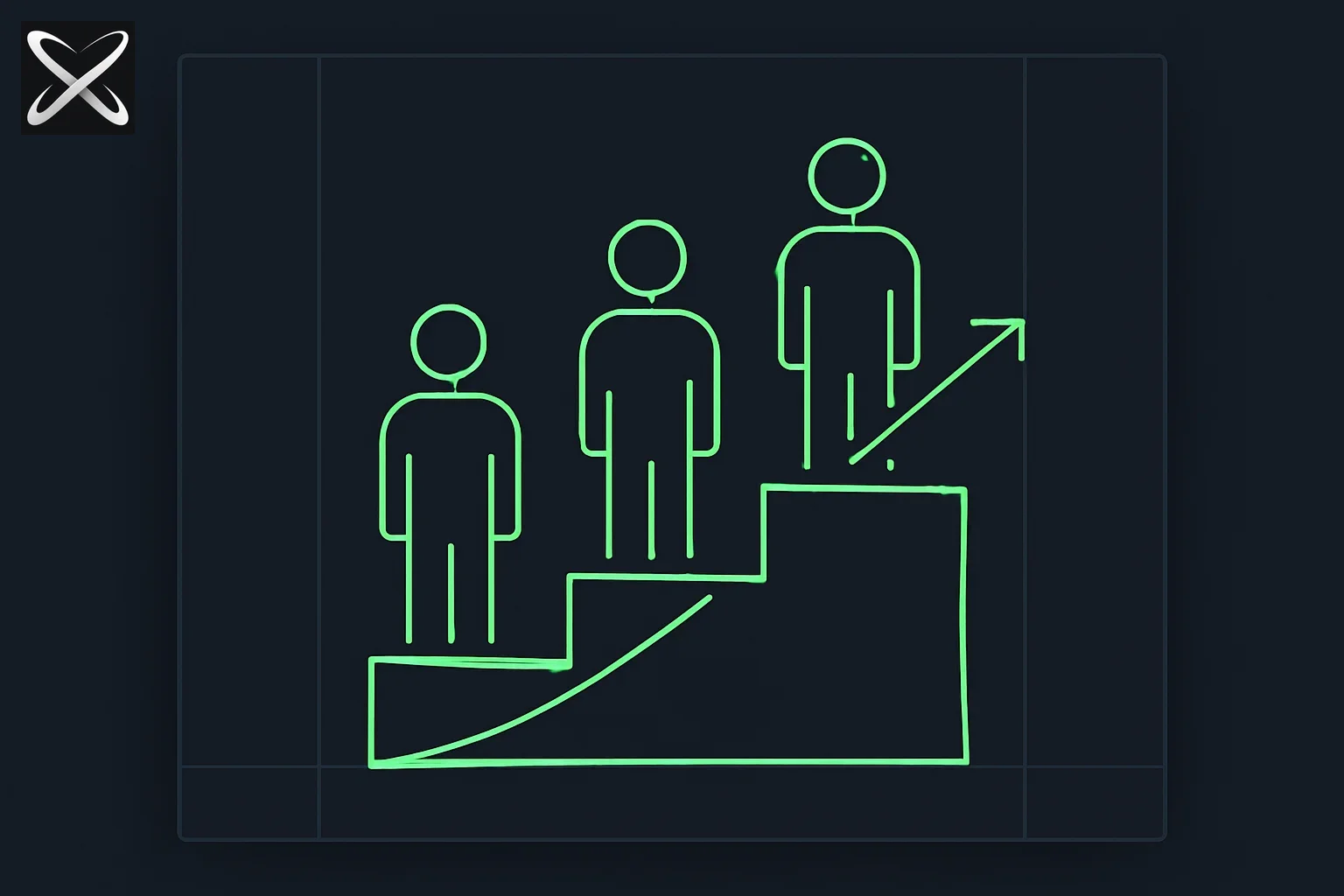
A useful framework is four levels:
Level 1 — Awareness: Understanding what AI can and cannot do; knowing what hallucination is and why it matters; being able to identify which types of tasks in their role could benefit from AI assistance. This is the floor — the minimum that all employees benefit from understanding, regardless of role.
Level 2 — Applied: Using AI tools daily for real work tasks; writing effective task specifications; building verification habits before outputs are used; knowing where to look when a new AI tool is relevant to their domain. This is the target level for most knowledge workers.
Level 3 — Advanced: Designing multi-step AI workflows for team or departmental use; evaluating tools critically (not just using them); fine-tuning prompts for consistent results at scale; building light automations. This is appropriate for power users, operations-minded managers, and analytical roles.
Level 4 — Builder: Building with AI APIs, deploying agents, fine-tuning models, integrating AI into products. This is for technical roles — engineers, data scientists, ML practitioners.
Most organizations need Level 2 for most of their workforce, Level 3 for their power users and analytical team leads, and Level 4 for their technical staff. The mistake is trying to build Level 4 capability in everyone, which is both expensive and unnecessary. The opposite mistake — stopping at Level 1 for everyone — leaves most of the capability gain on the table.
What Actually Works
Pull Learning Over Push Training
The most reliable predictor of whether AI learning sticks is whether the learner has a concrete problem they are trying to solve. People who come to AI training because their manager told them to have very different retention from people who came because they have a specific task they want to try automating.
This suggests that the most effective upskilling programs are designed around genuine use cases rather than generic curricula. Before any training investment, the most valuable question to ask your teams is: "What is one thing you do repeatedly that you wish took less time or required less effort?" Collecting those answers before designing the program dramatically increases relevance — and relevance drives retention.
Cohort Learning for Foundation-Building
Self-paced online courses have completion rates below 10% for most professional learners. Cohort-based learning — where a group goes through structured content together, with a shared schedule and collaborative discussion — consistently outperforms self-paced for skill development.
The reason is social accountability and cohort-specific discussion. When colleagues in the same cohort are applying the same frameworks to different parts of the same organization's work, the discussion that follows is more relevant than any pre-produced case study. This is why the AI Maker Bootcamp and similar structured programs with live cohorts consistently produce better outcomes than corporate self-study mandates.
For a team-level upskilling initiative, building in cohort structure — even informally, as a working group that goes through content together and meets weekly to discuss application — produces better outcomes than individual self-study assignments.
Daily Exposure for Maintenance
Skills built in an intensive learning block erode without maintenance. The field also keeps changing — tools released 6 months ago are sometimes already superseded by better options. A learning structure that builds knowledge once but has no maintenance layer will underperform.
What maintenance looks like in practice: 30-60 minutes per week of structured exposure to what is happening in AI relevant to your domain. This is different from doom-scrolling AI Twitter. It is curated, organized, and focused on practical signal rather than hype. A daily news digest from a source focused on AI tools and skills is one model. A structured reading group with a rotating summary is another.
The organizations doing this well tend to centralize this rather than leaving it to individual employees. A shared internal newsletter, a curated Slack channel, or a subscription to a platform that does this curation systematically ensures that even employees who would not self-seek this information stay current through low-friction daily exposure.
Practice on Real Tools, Not Demos
Training environments where employees practice with sample data on watered-down demos produce limited transfer to real work. The most effective upskilling programs put real tools in front of learners quickly — with real data (appropriately anonymized where needed), real tasks from their actual roles, and real outputs that go into real workflows.
The initial friction of using a real tool on a real task is higher than using a demo. The learning is also incomparably deeper. The first time someone's AI-assisted draft goes into a client deliverable — and they see how much editing it still needed, and where the agent confidently produced something wrong — is more formative than any number of course modules.
Role-by-Role AI Fluency Roadmap
What Level 2 applied fluency looks like varies by role. Here is a concrete breakdown for common professional roles.
Marketing Manager: Daily use of AI for content briefs and first draft copy; a systematic process for competitive monitoring using agent tools; understanding of when to trust AI-generated copy and when to rewrite; ability to evaluate AI-generated performance analysis claims before presenting them.
Financial Analyst: Consistent use of AI for report narrative drafts from structured data; a verification habit for any figure that appears in a deliverable; ability to write a data extraction specification that produces consistent outputs from similar documents; judgment about which analysis types AI handles reliably versus which need manual review.
Management Consultant: Reliable use of AI for client research synthesis and deck first drafts; ability to evaluate source reliability in AI-generated research summaries; a workflow for converting a consultant's story outline into a structured AI brief for content generation; understanding of when AI-generated analysis is a shortcut and when it is a shortcut to the wrong answer.
HR Manager: Deployed use of AI for routine policy Q&A (with appropriate review) and job description drafting; ability to evaluate AI-assisted resume screening outputs for bias and accuracy; judgment about where AI should not be used in employee relations and why.
Legal Analyst: Consistent use of AI for contract first-pass review against a defined checklist; ability to specify a legal research brief that produces useful starting points; a reliable verification process before any AI-assisted work leaves the team; clear understanding of what AI cannot safely do in a legal context.
The pattern across all roles: AI fluency at Level 2 is not about knowing the most tools. It is about having a small number of workflows that work reliably, a verification habit that is second nature, and judgment about where to stop delegating.
Building the Learning Infrastructure
A team-level AI fluency program needs three components to be sustainable.
1. A shared signal layer: Some systematic way for your team to stay current with what is changing in AI relevant to their domain. This could be a curated weekly digest, a shared bookmarking system, or a subscription to a platform that surfaces new tools and developments with context rather than just a list of announcements.
Platforms like explainx.ai are designed for this — they rank skills, tools, and AI developments by actual adoption, and the daily news digest is organized around what practitioners are actually using rather than what vendors are promoting. At $29/month, the subscription gives team members access to the skills registry, AI chatbot, and monthly course drops — a reasonable infrastructure investment for a team that wants to stay current without spending hours curating their own reading list.
2. A skill-building structure: A defined path from Level 1 to Level 2 for knowledge workers, with a cohort format where possible. The AI Maker Bootcamp is one option for teams who want instructor-led, cohort-based learning with real-world application built in. For teams that need something more internal and role-specific, building a 4-6 week structured program around real use cases from your own workflows is worth the design investment.
3. A practice environment: Real tools. Real tasks. No watering-down. The first few sessions should get team members working with AI on actual tasks from their jobs — not hypotheticals. The friction of real tasks is where the most important learning happens.
New evidence guides for individual learners and hiring teams
Use the AI skills employers actually want to translate job-posting language into a learning plan, then follow the AI career-change roadmap for non-developers to produce a measured portfolio artifact. Our case against AI certificates before building explains why course completion needs observable work beside it, while the 2026 job-displacement data check separates real entry-level pressure from mass-layoff headlines.
How to Start This Week
If you are an L&D leader: Run a use case audit before any training investment. Survey your teams with one question: "What is one task you do regularly that you wish took half as much time?" Map the answers to AI capability categories. Design your curriculum around the categories that appear most frequently.
If you are a manager: Pick one workflow your team does repeatedly. Work with one or two willing team members to document the task specification and test an AI workflow against it. Use that as a demonstration case for the rest of the team. People learn from colleagues' examples faster than from external training.
If you are designing the long-term program: Plan for three time horizons. An intensive 4-8 week foundation block for knowledge workers who do not yet have Level 2 fluency. A set of role-specific advanced sessions for power users. And a continuous maintenance layer — daily or weekly — that keeps everyone's knowledge current as the field evolves. The foundation block is a one-time investment. The maintenance layer is the ongoing operating cost of a team that stays ahead.
The Real Measure of Success
Twelve months from now, the organizations that will have the most capable AI-fluent teams are not those that spent the most on training. They are those that:
- Built in verification habits alongside productivity expectations, not just speed
- Treated role-specific application as the unit of learning design, not generic AI concepts
- Built a continuous maintenance layer rather than treating upskilling as a one-time event
- Measured whether work changed, not whether modules were completed
AI fluency is not a destination. The field will keep changing, and staying fluent requires a system, not a certificate. Organizations that build the system — even imperfectly — will compound their advantage over those that treat this as a solved problem once the first training is done.
The half-life of AI knowledge without a maintenance system is getting shorter, not longer. Build for that.
Update — August 21, 2026: For the learning-science frame behind cohort + dialogic practice — and how explainx.ai implements it via Melo, team workspaces, and live workshops — see social learning for AI.