Render Mermaid diagrams in real-time with live preview, browser refresh, WebSocket updates, and SVG/PNG/PDF export plus
 by
by Add new capabilities to Claude beyond text generation
Example: Access external data sources, execute code, interact with tools and services
Transform Claude from chatbot to action-taking agent
Provide Claude with access to relevant context and data
Example: Load project documentation, access knowledge bases, query databases
Get more accurate, context-aware responses
Automate multi-step workflows combining AI and external tools
Example: Research → Summarize → Create document → Send notification
Complete complex tasks end-to-end without manual steps
Time estimate: 15-60 minutes depending on server complexity
Prerequisites
GitMCP
Supercharge your AI code assistant with GitMCP—get accurate, up-to-date code and API docs from any GitHub project. Free,
JsonDiffPatch
JsonDiffPatch: compare and patch JSON with a compact delta format capturing additions, edits, deletions, and array moves
Intercom
MCP server for Intercom — enables Claude to interact with Intercom data and workflows.
Pulumi Infrastructure as Code
Pulumi Infrastructure as Code enables infra as a code operations, with tools for querying resources and running CLI comm
Slack MCP Server (Official)
Official Slack MCP server enabling AI agents to interact with Slack workspaces through the Model Context Protocol. Featu
Strong directory entry: Mermaid surfaces stars and publisher context so we could sanity-check maintenance before adopting.
We wired Mermaid into a staging workspace; the listing’s GitHub and npm pointers saved time versus hunting across READMEs.
Strong directory entry: Mermaid surfaces stars and publisher context so we could sanity-check maintenance before adopting.
Useful MCP listing: Mermaid is the kind of server we cite when onboarding engineers to host + tool permissions.
Mermaid has been reliable for tool-calling workflows; the MCP profile page is a good permalink for internal docs.
We evaluated Mermaid against two servers with overlapping tools; this profile had the clearer scope statement.
Mermaid has been reliable for tool-calling workflows; the MCP profile page is a good permalink for internal docs.
According to our notes, Mermaid benefits from clear Model Context Protocol framing — fewer ambiguous “AI plugin” claims.
According to our notes, Mermaid benefits from clear Model Context Protocol framing — fewer ambiguous “AI plugin” claims.
Mermaid is among the better-indexed MCP projects we tried; the explainx.ai summary tracks the official description.
showing 1-10 of 44
Share your MCP server with the developer community
Select a client to integrate this server.
Claude Desktop configuration
{
  "mcpServers": {
    "mermaid": {
      "command": "claude-mermaid",
      "args": []
    }
  }
}Renders Mermaid diagrams with live preview in your browser that automatically updates as you edit code. Supports multiple export formats and themes with interactive pan/zoom controls.
Mermaid is a community-built MCP server published by veelenga that provides AI assistants with tools and capabilities via the Model Context Protocol. Render Mermaid diagrams in real-time with live preview, browser refresh, WebSocket updates, and SVG/PNG/PDF export plus It is categorized under developer tools, design.
You can install Mermaid in your AI client of choice. Use the install panel on this page to get one-click setup for Cursor, Claude Desktop, VS Code, and other MCP-compatible clients. This server runs locally on your machine via the stdio transport.
MCP server for rendering Mermaid diagrams in Claude Code with live reload functionality and a built-in skill for expert guidance.
Automatically renders diagrams in your browser with real-time updates as you refine them. Perfect for iterative diagram development and documentation workflows.
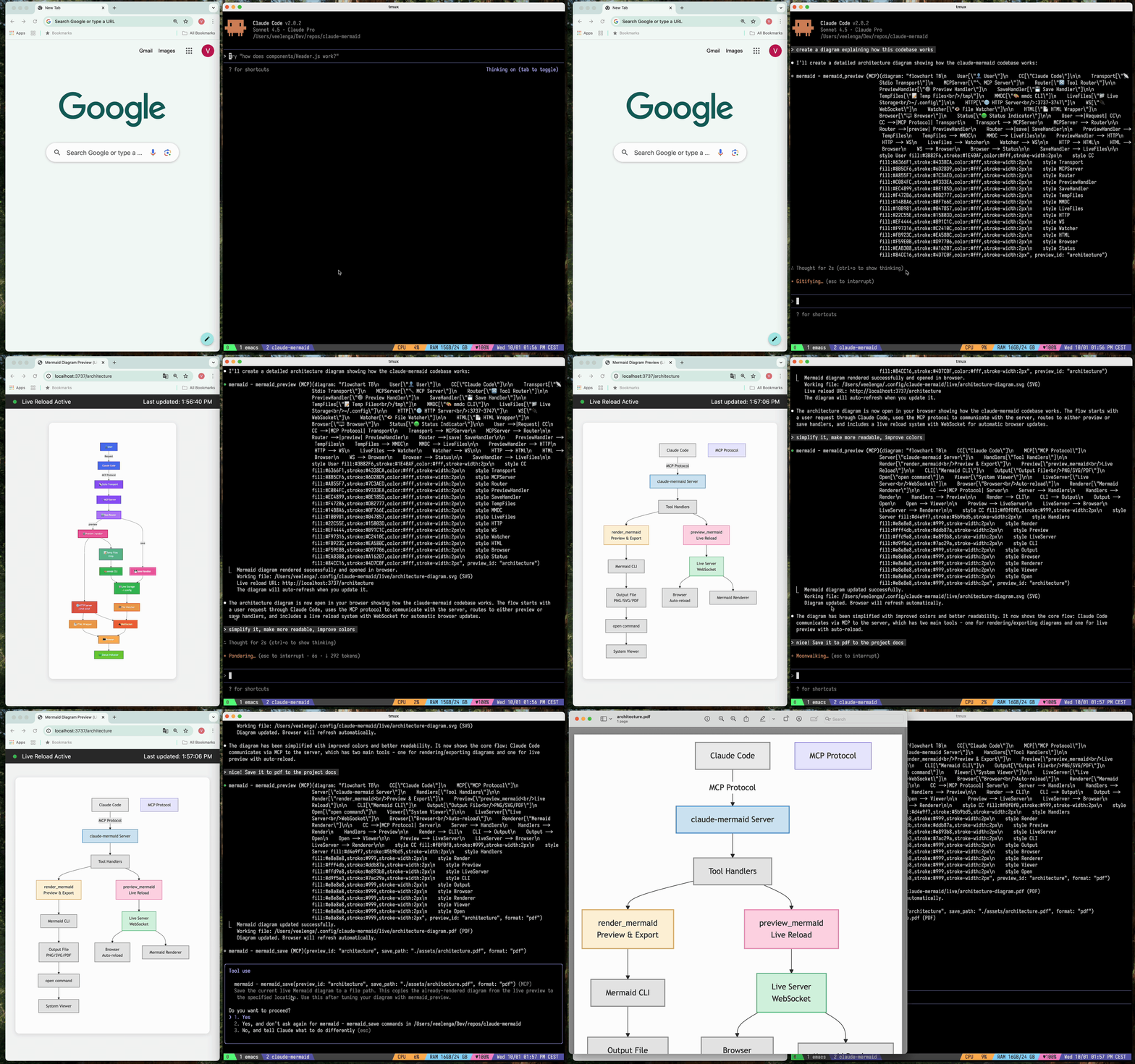
preview_id to work on multiple diagrams simultaneously~/.config/claude-mermaid/live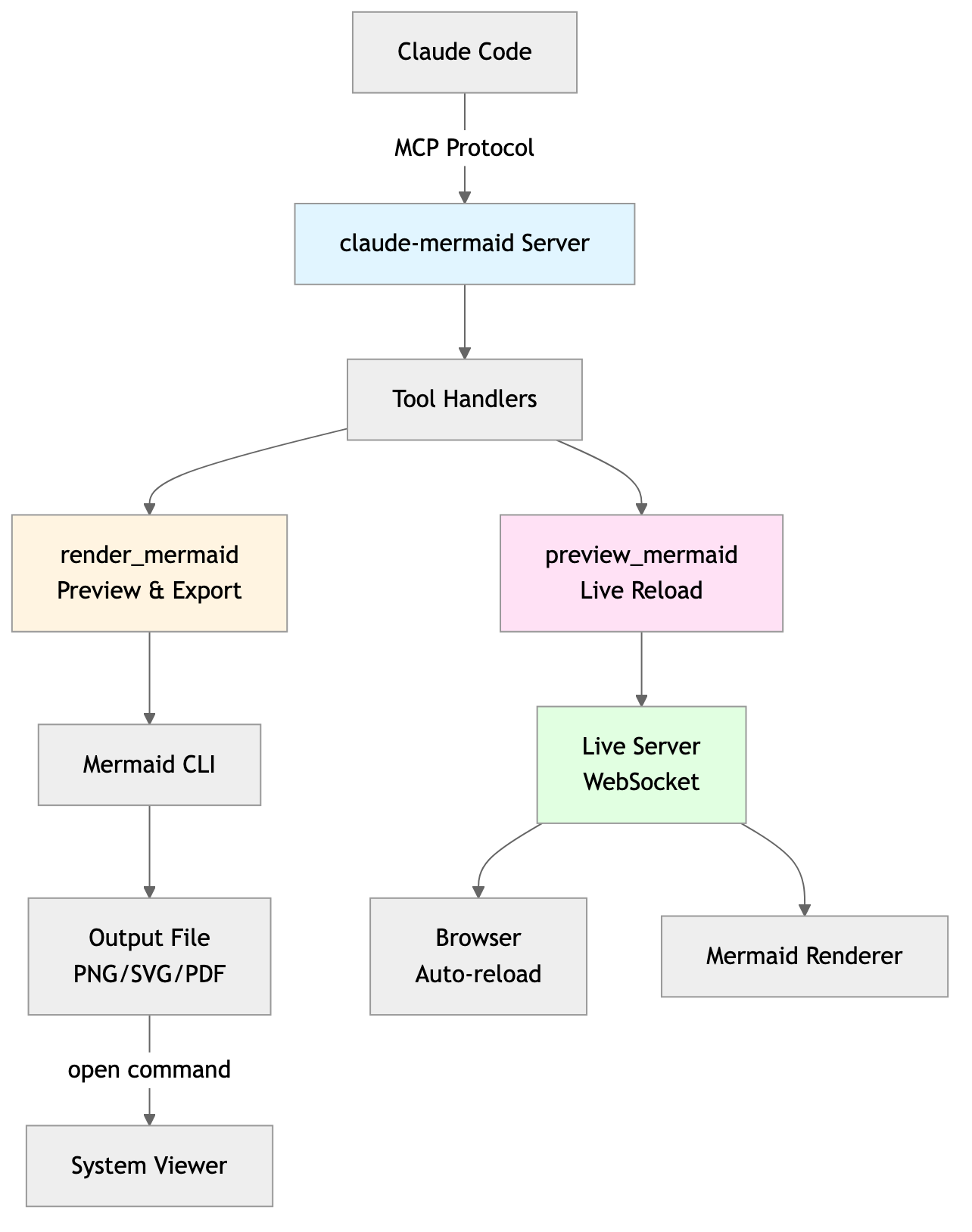
Plugin Install (Recommended)
In Claude Code, add the marketplace and install the plugin:
/plugin marketplace add veelenga/claude-mermaid
/plugin install claude-mermaid@claude-mermaid
Then restart Claude Code to activate the plugin.
From npm:
npm install -g claude-mermaid
From source:
git clone https://github.com/veelenga/claude-mermaid.git
cd claude-mermaid
npm install && npm run build && npm install -g .
Plugin install: The MCP server is configured automatically. Just verify:
/mcp
You should see mermaid in the MCP server list.
npm install: Configure the MCP server manually:
claude mcp add --scope user mermaid claude-mermaid
Then verify:
claude mcp list
You should see mermaid: claude-mermaid - ✓ Connected
While this server is optimized for Claude Code, it can work with any MCP-compatible client. Here's how to configure it for other popular tools:
<details> <summary><strong>Codex</strong></summary>Add to your Codex MCP settings file (~/.codex/mcp_settings.json):
{
  "mcpServers": {
    "mermaid": {
      "command": "claude-mermaid"
    }
  }
}
Or configure via Codex CLI:
codex mcp add mermaid claude-mermaid
Add to your Cursor MCP config file (.cursor/mcp.json or settings):
{
  "mcpServers": {
    "mermaid": {
      "command": "claude-mermaid"
    }
  }
}
Or use Cursor's settings UI:
claude-mermaidIf using the Cline extension for VSCode:
{
  "mcpServers": {
    "mermaid": {
      "command": "claude-mermaid"
    }
  }
}
Add to Windsurf's MCP configuration file:
{
  "mcpServers": {
    "mermaid": {
      "command": "claude-mermaid"
    }
  }
}
Configuration location varies by platform:
~/Library/Application Support/Windsurf/mcp.json~/.config/windsurf/mcp.json%APPDATA%\Windsurf\mcp.jsonAdd to Gemini CLI's MCP configuration file (~/.gemini/mcp.json):
{
  "mcpServers": {
    "mermaid": {
      "command": "claude-mermaid"
    }
  }
}
Or use the Gemini CLI to configure:
gemini config mcp add mermaid --command claude-mermaid
For any MCP-compatible client, use the standard configuration:
{
  "mcpServers": {
    "mermaid": {
      "command": "claude-mermaid"
    }
  }
}
The command claude-mermaid should be available in your PATH after installation.
Note: Some clients may require the full path to the executable:
which claude-mermaid (Unix/macOS) or where claude-mermaid (Windows)"command": "/path/to/claude-mermaid"Simply ask Claude Code to create Mermaid diagrams naturally. When installed as a plugin, the built-in mermaid-diagrams skill provides expert guidance, best practices, and automatic workflow management.
"Create a Mermaid diagram showing the user authentication flow"
"Draw a sequence diagram for the payment process"
"Generate a flowchart for the deployment pipeline"
With custom formatting:
"Create a dark theme architecture diagram with transparent background"
"Generate a forest theme flowchart and save to ./docs/flow.svg"
With specific output format:
"Create an ER diagram and save as PDF to ./docs/schema.pdf"
"Save the flowchart as PNG to ./docs/flow.png"
Note: Browser always shows SVG for live preview, while saving to your chosen format.
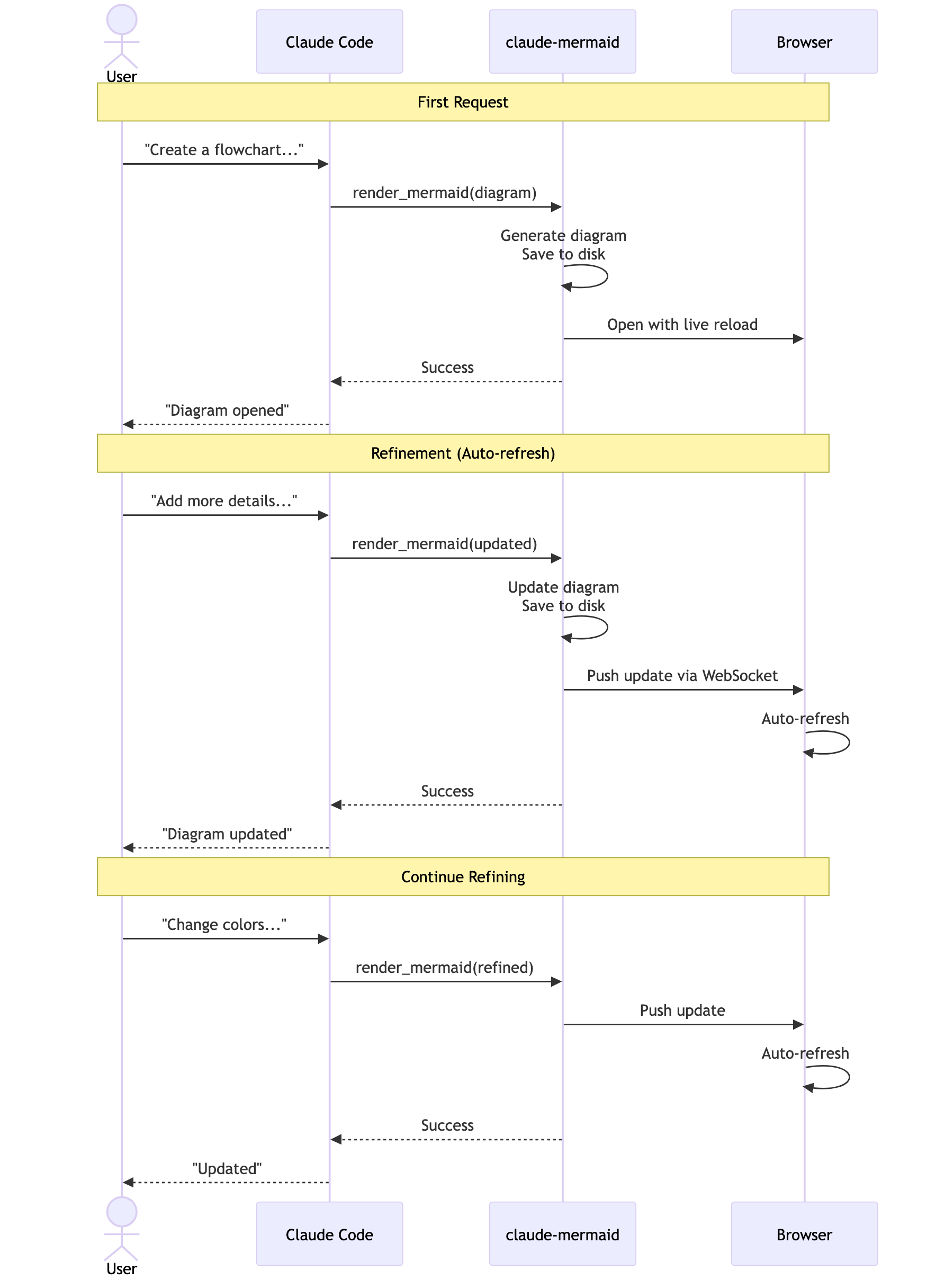
Iterative refinement:
"Create a class diagram for the User module"
// Browser opens with live preview
"Add the Address and Order classes with relationships"
// Diagram updates automatically in browser!
"Create a flowchart and save to ./docs/auth-flow.svg:

graph LR
    A[User Login] --> B{Valid Credentials?}
    B -->|Yes| C[Access Granted]
    B -->|No| D[Access Denied]
    C --> E[Dashboard]
    D --> F[Try Again]

    style A fill:#e1f5ff
    style C fill:#d4edda
    style D fill:#f8d7da
"
The diagram will be saved to ./docs/auth-flow.svg and opened in your browser with live reload enabled.
There are two tools exposed by the MCP server:
mermaid_preview — render and open a live previewdiagram (string, required) — Mermaid diagram codepreview_id (string, required) — Identifier for this preview session. Use different IDs for multiple concurrent diagrams (e.g., architecture, flow).format (string, default svg) — One of svg, png, pdf. Live preview is available only for svg.theme (string, default default) — One of default, forest, dark, neutral.background (string, default white) — Background color. Examples: transparent, white, #F0F0F0.width (number, default 800) — Diagram width in pixels.height (number, default 600) — Diagram height in pixels.scale (number, default 2) — Scale factor for higher quality output.mermaid_save — save the current live diagram to a pathsave_path (string, required) — Destination path (e.g., ./docs/diagram.svg).preview_id (string, required) — Must match the preview_id used in mermaid_preview.format (string, default svg) — One of svg, png, pdf. If the live working file for this format doesn’t exist yet, it is rendered on demand before saving.http://localhost:3737/{preview_id}The live server uses ports 3737-3747 and automatically finds an available port.
svg format only; PNG/PDF are rendered without live reload.style directives inside sequenceDiagram.You can start the preview server without an AI agent using the --serve flag:
claude-mermaid --serve
This opens the diagram gallery in your browser with all previously rendered diagrams. Useful for browsing and exporting diagrams outside of a Claude Code session.
# Install dependencies
npm install

# Build the project
npm run build

# Run tests
npm test

# Watch mode for development
npm run dev

# Start the MCP server directly
npm start
Error: Cannot find package 'puppeteer':
This is a rare environment-specific issue. Try these solutions:
Install claude-mermaid globally:
npm install -g claude-mermaid
Reinstall the plugin in Claude Code:
/plugin uninstall claude-mermaid
/plugin install claude-mermaid@claude-mermaid
Server not connecting:
# Check if server is installed
claude-mermaid -v

# Reinstall if needed
npm install -g claude-mermaid

# Verify MCP configuration
claude mcp list
Permission denied error:
# Make sure the binary is executable
chmod +x $(which claude-mermaid)
**Port alread
Steps
Troubleshooting
✓ Do
✗ Don't
💡 Pro Tips
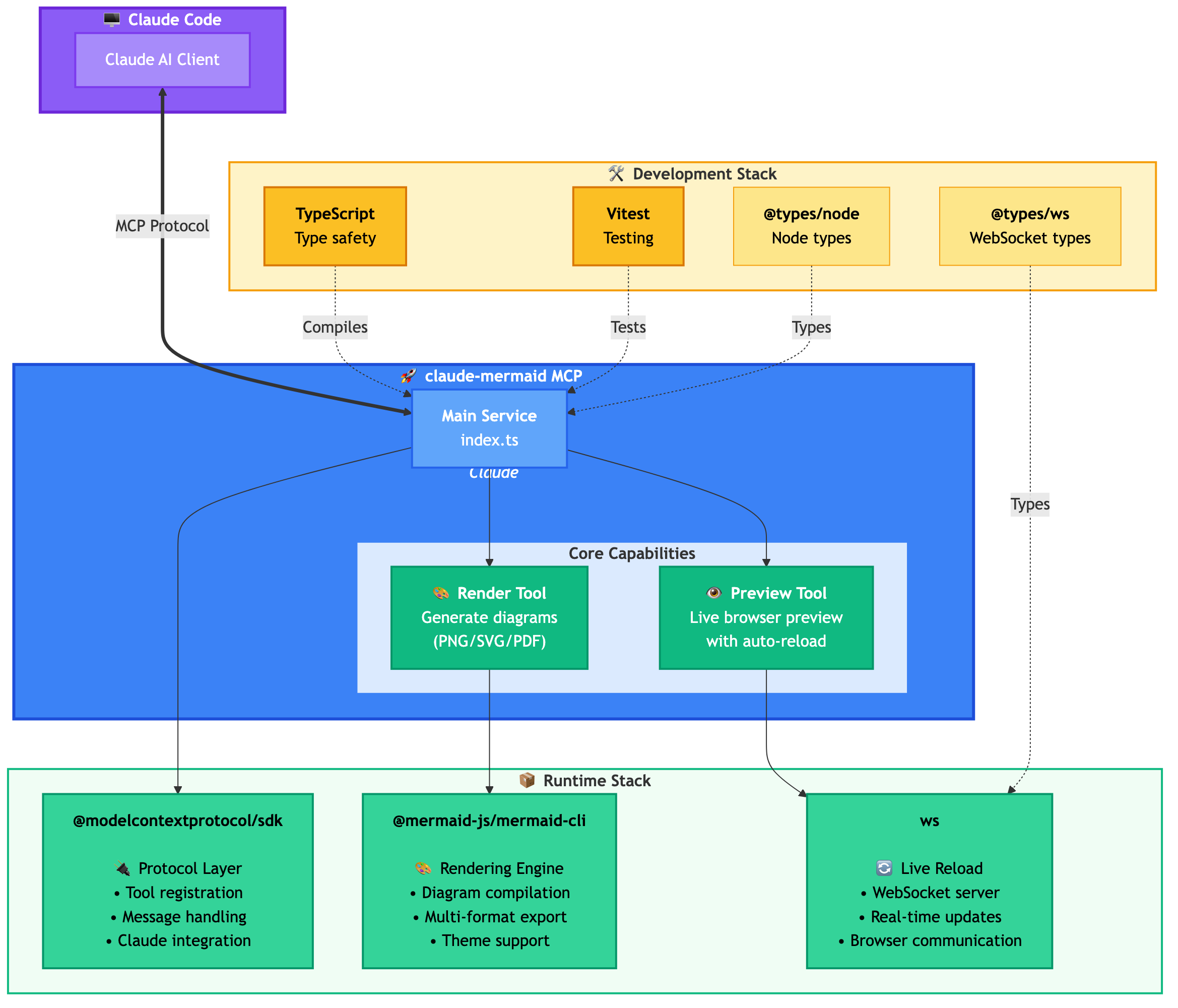
Architecture
Model Context Protocol standardizes how AI hosts (Claude, Cursor) communicate with external tools and data sources through server implementations.
Protocols
Compatibility
✓ Use when
Use when you need Claude to access external data, execute actions, or integrate with tools. Best for extending AI capabilities beyond conversation.
✗ Avoid when
Avoid when native integrations exist (use official APIs directly), for real-time critical systems, or when security/compliance requires zero external dependencies.



